
Vanessa White (violin) and Tom Jesty (piano)

What a way to start our 2025 Lunchtime Recital series! Vanessa and Tom gave us a well-balanced and melodious programme which played to their personal styles and their partnership. Once again, a great opportunity to get close up, both to hear the music and experience the emotions of the artists and the interplay between them.
We particularly appreciated Tom’s introductions and the moments he illustrated his points at the piano, so we’d know what to listen for – in so drawing us in and making it more personal for each of us.
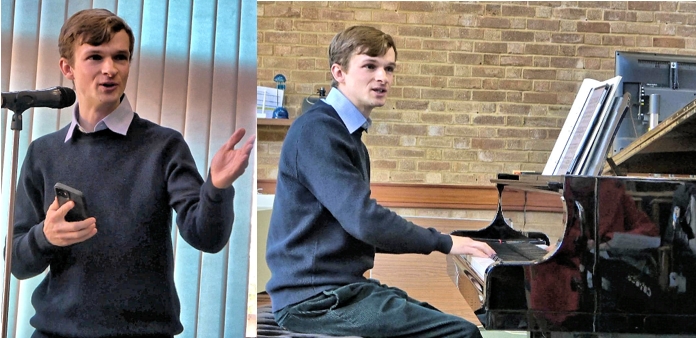
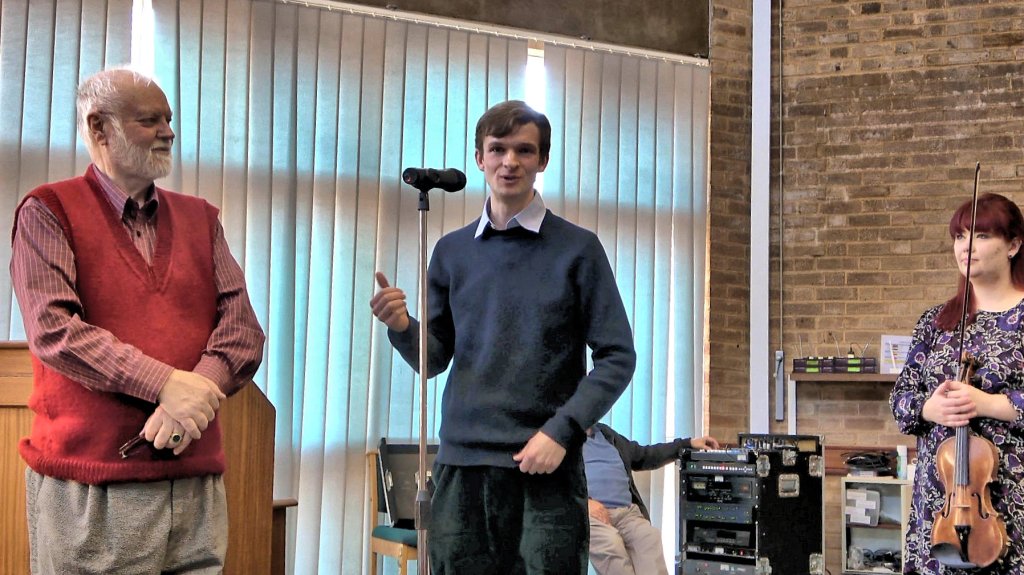
Our MC Tony Corfe’s “interrogation” of Vanessa and Tom after the recital we learned a bit about her violin (a French violin from the 1700’s) and very special bow bought with her grandfather’s inheritance.
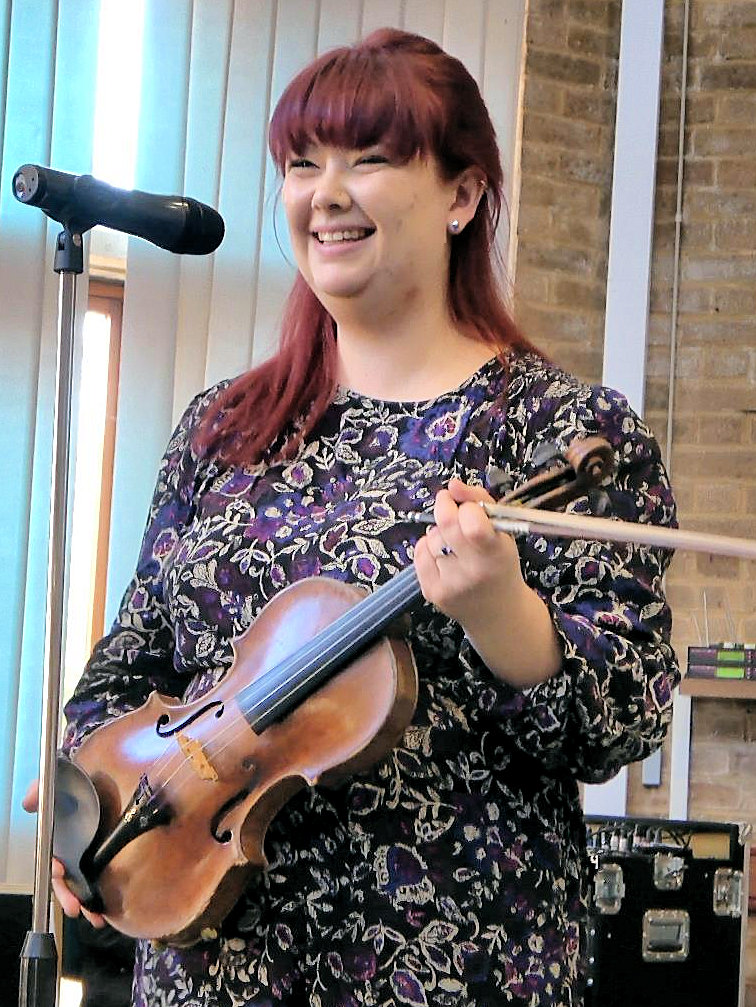
We also established that Tom had started singing in choirs at the age of 8 and that both he and Vanessa had a history as choristers behind them, so we may hope (well Tony asked) that perhaps when they come next year, they will allow us to sample that skill as well.
Programme:
Tempo di Minuetto Fritz Kreisler (1875-1962)
Sérénade mélancholique op.26 Pyotr Ilyich Tchaikovsky (1840-1893)
Variations on a theme by Corelli Fritz Kreisler (1875-1962)
Sonatine in G major for violin and piano, op.100 Antonin Dvořák (1841-1904)
- Allegro risoluto
- Larghetto
- Scherzo – Molto vivace
- Finale – Allegro
L’Abeille (The Bee) no 9 from Bagatelles op.13 François Schubert (1808-1878)
Our programme begins with a short work by Fritz Kreisler. Kreisler was famed for writing works for violin, and many of these were pastiches of other composers’ writing styles. The Tempo di Minuetto is one such piece; it exemplifies the writing style of Italian composer Gaetano Pugnani. This is not the only pastiche Kreisler composed in Pugnani’s style – the other being the famous Praeludium and Allegro.
Tchaikovsky composed his Sérénade mélancholique for the Hungarian virtuoso violinist Leopold Auer in 1875. However, the piece received its première from Adolph D. Brodsky, a professor at the Moscow Concservatory, in 1976. As was the case with his Valse-Scherzo op.34 and the famous Violin Concerto op.35, Tchaikovsky intended this music to be performed as a violin-piano duo piece as well as with orchestra. The work found immediate popularity and has remained a staple of the violin virtuoso repertoire ever since. We continue our programme with another work by Kreisler, this one a set of variations on a theme by the baroque composer, Arcangelo Corelli. The theme is taken from the Gavotte from the latter composer’s F major violin sonata op.5 no.10. The opening strikes a note of grandeur, which gives way to dazzling passage work for the violinist in the central sections, before a triumphant return to the theme to close.
Antonin Dvořák’s dates are very similar to those of Tchaikovsky, though his idiom is strikingly different. He wrote his Sonatine for violin and piano in 1893, while he was director of the National Conservatory of Music of America in New York, intending for it to be enjoyed by his two children: fifteen-year-old Otilie and ten-year-old Toník. It is full of youthful playfulness and exuberance, and, as can be heard in his ‘Symphony From the New World’ of the same year, the joy in combining America’s folk music with the European tradition in which Dvořák was educated is evident.
We close our programme with a short character piece by the German composer François Schubert (not to be confused with the famous Austrian, Franz Schubert of an earlier generation). The piece is titled ‘The Bee’, and the buzzing of the bee is clearly heard in the violin part throughout.
 Potters Bar United Reformed Church