
An Introduction to the Ondes Martenot (Martenot Waves) and Recital by Malcolm Ball – 9th July 2024

This was indeed a rare chance to see and hear the exciting sounds of the Ondes Martenot (Martenot Waves). Unfortunately we missed out the sound during the first part of Malcolm’s introduction, so I’ve used the Internet to fill the gaps (below). Malcolm took us through the essence of the instrument during the session illustrating the effects created as he went and then playing through his programme consecutively to demonstrate its full capabilities.
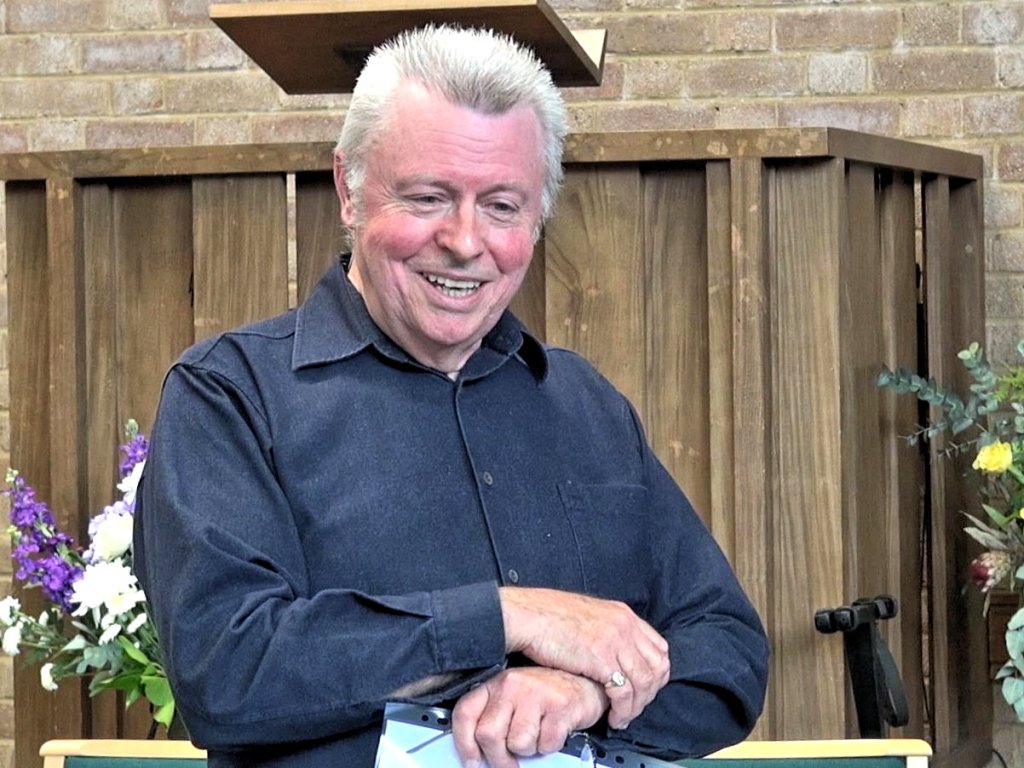

His accompanist, Peter Humphreys, had died a couple of months earlier but had recorded many pieces which Malcolm used during the recital.
Ondes Martenot is an electronic musical instrument created in 1928 in France by Maurice Martenot. Martenot was inspired by the accidental overlap of tones between military radio oscillators and wanted to create an instrument with the expressiveness of the cello. The oscillating radio tubes produce electric pulses at two supersonic sound-wave frequencies. In combination, they in turn produce a lower frequency within audible range that is equal to the difference in their rates of vibration, and this is amplified and converted into sound by a loudspeaker. Many timbres, or tone colours, can be created by filtering out upper harmonics, or component tones, of the audible notes – as Malcolm demonstrated.
In the earliest version, the player’s hand approaching or moving away from a wire varied one of the high frequencies, thus changing the lower frequency and altering the pitch. Later, a wire was stretched across a model keyboard; the player moved a ring along the wire to vary the frequency. In a more recent version, the frequency changes are controlled from a functioning keyboard. The keys produce vibrato when moved from side to side. Malcolm’s instrument has both keyboard and ring options and he could switch between the two as the mood and the music took him.

No sound is heard at all until a button known as the “touché” housed in a drawer is depressed with the left hand. This is connected to a potentiometer and so acts rather like the air blown through a wind instrument; the harder you press the louder the sound on the keyboard. (Martenot had been a cello player and sought similarities, both in this respect and also the ability to change the note by moving a finger along the string as you do with a violin or cello.
Also in the drawer are a number of electronic filters which change timbre and dynamics which together with the vibrato create great possibilities of expression dependent on the gestures of the performer – which Malcolm demonstrated for us.

The sound is amplified through a 4-speaker system one of which has a small gong positioned in front of it producing a metallic reverberation another is the ‘Palme’ a lyre-shaped loudspeaker, using strings to produce sympathetic resonances. Various combinations of these speakers can be used at any one time.

Programme
Charles Koechlin (1867-1950) – Monodies for Ondes Martenot (No.1 Réveil dans la lumiére).
Georges-Léonce Guinot (1922 -) – Le Coin des Animaux (Berceuse du Faon).
Edward Elgar (1857-1934) – Salut d’Amor
Ryuichi Sakamoto – (1952-2023) – Rebirth 2 (Goodbye to Hawk) – for the film The Revenant
Stanley Myers (1930-1993) – Cavatina. – signature tune for the film The Deer Hunter
Mystery Item – which turned out to be the music played with the credits for the film Ghostbusters
Olivier Messiaen (1908-1992) – Feuillets Inédits (No.4).
 Potters Bar United Reformed Church