
Communion Service Sunday 10th August – led by Revd. David Aplin
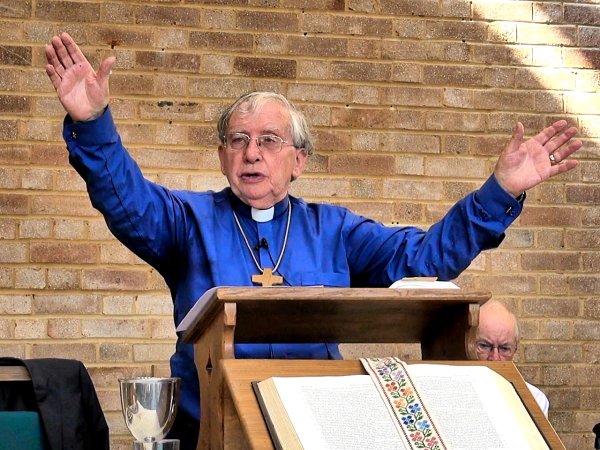
The reading from Luke 12 presented us with a challenge. It was pretty apparent that the writer believed that Jesus was talking about events that would happen within the lifetime of his audience. And this was clearly the belief of the early church. So what did “Being ready” mean for us?
David saw the gospel reading comprising 3 sections. An opening section where Jesus had set out a principle, a parable in the middle that had illustrated it, and then a short, sharp, summary so that Jesus could get home the message he was giving to people.
The first part was promise to his disciples, to a few, and to us. “Do not be afraid, little flock, for it is your father’s good pleasure to give you the kingdom”. The Father had given us great treasure, all that there was. He’d not selfishly held on to the kingdom that He had created. The kingdom was to be shared with us – not just this world on earth, but the heavenly kingdom.
David noted that there had been many despots in the history of the world, and most had ultimately come to a sticky end (and he clearly harboured similar thoughts for those currently on the world stage). All those evil men had common characteristics of arrogance, self-importance, and a disregard for others – selfish and cruel.
We should contrast this with our God. God had created a wonderful world for us; had created us, given us talents, and most importantly the right to choose. If we’d been created with being good hard-wired into us, we would have been lesser as individuals and not reached the heights (or plumbed the depths). The power to choose between good and evil was what set us apart from other animals – it was godlike.
How different was our God to those evil despots. He put our needs first, and he wanted to share what He had created with us. And He had sent His Son to show us the way. As a human Jesus had suffered arrest, torture, and a cruel death upon the cross. But worse than the physical pain suffered by Jesus was, how his heart was broken by those who rejected him during his ministry and in Jerusalem, Judas who betrayed him, Peter who denied him, and even his Father, “My God! My God! Why have you forsaken me?”. His heart was broken before his body, but God had been with him on that cross, and his faith was restored, “Father, into your hands I commit my spirit”.
Jesus had trusted God, and so could we. Our reward, our prize would be nothing less than the kingdom of God in this world and the next. Talk about death seemed to be a passion of our time. We should not worry about the body, it was the soul that lived on in eternal life. The Son of Man would come to take our spirits to safety in our Father’s house. We should treasure our faith in God, be confident of it, and we would be ready to share the wonderful gift from God – the gift of His kingdom for all eternity. Through Jesus Christ our sins were forgiven, and we would have life eternal.
David talked about one particular evil actor on the current world stage, predicting that his time would come. And yet that man was a Christian. His actions might lead us to doubt that, but faith is a personal thing. And if he had faith in God and repented of his actions………………………………………….?
Two uncomfortable questions.
 Potters Bar United Reformed Church