
Sunday 9th March 2025 – Family Service led by Canon Richard Osborn
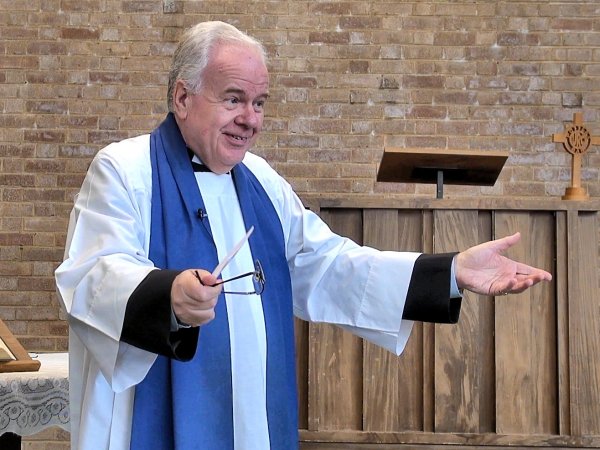
It seems that this year Richard has brought the spring with him, with warm and sunny weather to brighten our spirits. We were starting on our Lenten journey and Richard reminded us of the commandments of our Lord God, suggested a moment of honest reflection, and a confession to God of our failure to keep all of those commandments.
So last Wednesday was Ash Wednesday and Richard recounted to us that he had been born on Ash Wednesday. His mother told a story of this dreadful panic. They had brought her to hospital on the Tuesday which she thought had helped his arrival. Lent may have derived from Lenz, the German word for Spring, or perhaps a Norwegian word reflecting the lengthening of the days, and we were conscious of springtime – the snowdrops, the crocuses, the daffodils.
Lent was the time when we prepared for Holy Week, Good Friday, and for Easter in just under 6 weeks. It had come to be associated with Jesus’s time in the wilderness, fasting for 40 days (and he noted that as the period was more than 40 days it would not include the Sundays – days off so to speak?) . For many people Lent was a period of giving something up, reflecting this idea of fasting. Denying ourselves was an important part of Lent, but Richard thought that we might also be thinking about taking something extra on – a more positive way of observing Lent. It might be more time spent studying the Bible, or additional time for prayer. We were encouraged to “dare to make a difference”, to do something that improved the life of others; something that made a difference to them, and in that way, we’d be following in the footsteps of out saviour Jesus Christ.
The focus of Richard’s Address was temptation, and he recalled the words of Oscar Wilde. “ I can resist anything except temptation” – a clever saying, highlighting our fundamental weakness to give in to tempting things, all the while imagining that we can hold firm and resist them – perhaps even the temptation to believe that we could manage perfectly well without God.
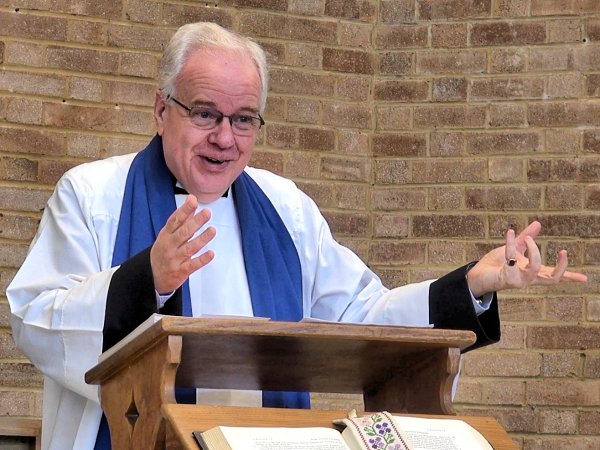
On this first Sunday of Lent, we traditionally considered the temptations of Jesus during his 40 days in the wilderness, but Richard drew our attention to the very last sentence of the day’s reading from Luke. ‘When the devil had finished tempting Jesus in every way, he left him for a while’. The temptations had not ended with the three familiar temptations. The inner struggles would recur, and he speculated on which occasions these might have been. These included Jesus’ thoughts in the garden of Gethsemane just before his arrest on the night before he died. The temptation must have been so great at that moment not to see his mission through to the end. The human side of Jesus might have been tempted to duck out of it at that moment. And even when he was nailed to the cross and had heard the taunts of the onlookers, ”If you are the King of the Jews, save yourself”, he surely could have done that. But no, he saw things through to the end. He resisted temptation.
So we’d be wrong to believe that the temptations of Jesus finished with the episode in the wilderness. One of the great spiritual writers, Thomas à Kempis had written, “No man (or woman) is so perfect and holy as not to have sometimes temptations, and we cannot be holy without them”. Another writer had put it, “We’re not tempted because we’re evil. We’re tempted because we’re human and temptations are part and parcel of the human condition”.
The one common factor all three of Jesus’ tests, Richard told us, was the temptation to instant action. Provide food now. Establish your kingdom now. Now show yourself as Messiah. A very 21st century temptation. The need for instant answers, instant satisfaction. We were all conditioned more than we sometimes supposed by a society which required instant cures and immediate solutions. But there were many spheres of life which did not leave room for such quick and easy answers – personal relationships, for example. These had to be worked at and needed patience and perseverance, whether it be in marriage or in other family relationships or friendships. They required constant care and sensitivity.
We might be tempted to take instant decisions, to react immediately to certain situations, make a quick condemnation of something or someone, speak hastily out of turn. But hopefully the love and friendship of our loved ones allowed them to offer us another chance.
Well, it was the same with God. He immediately loved and accepted us. But if that love and acceptance was to mean anything to us, it had to be dwelt upon, worked at, renewed and refreshed – and Lent reminded us of that need to recall us to the good habits which we might have let fall into disuse, or possibly never have taken up. It was notable that in the reading from Luke Jesus countered temptation not by having an argument with the devil but by quoting Scriptures.
Now we might be asking why Richard had focused on the temptation for instant action. It was because the temptations which Jesus met were not necessarily temptations to do evil things. Jesus had wanted the hungry to be fed. He’d wanted God’s kingdom to be evident here on earth. And he’d wished everyone to recognize him as the Anointed One of God, the Messiah. But, as we’d heard, he’d remained firm.
We long for justice, righteousness, and the spread of the Gospel, but we must not be impatient or tempted to unorthodox means, to wrong methods, merely to achieve instant success. Things might not move quickly enough for us and the seeds we were sowing now might not bear fruit for some considerable time, and we might never see their results. But God would, and that was all that mattered. Jesus had rejected the ways of bribery, magical powers, and force. Might we be filled with a similar spirit of patience and tolerance and draw on the Word of God for comfort. Whatever we chose to do this Lent, it was likely that we would be tempted over the 40 days because we were only human. But as St. Paul reminded us, if we confessed that Jesus was Lord and believed that God raised him from death, we would be saved.
 Potters Bar United Reformed Church