
Sunday 2nd March 2025 – Communion Service led by Anne Walton
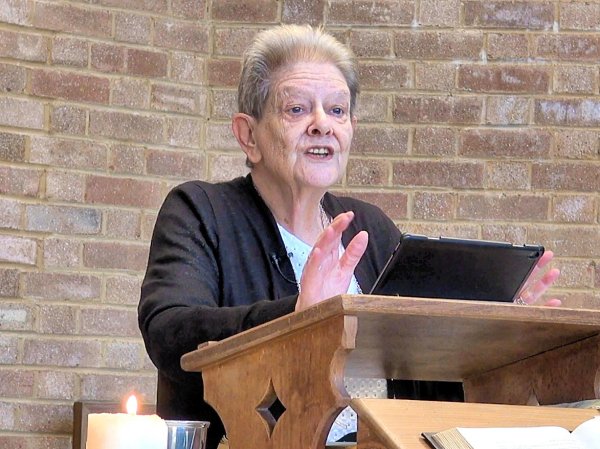
Good to have Anne with us again and seemingly feeling no ill-effects from David Ramsay’s 80th party the afternoon before (actually we were all of us still on a ‘high’).
Anne spoke to Luke 9, The Transfiguration, leading in by telling us that in different translations the disciples had been either actually asleep and woken up; or just tired and not really looking at what was going on around them. This took her to Amy-Jill Levine’s book ‘The Bible with and without Jesus’ which was full of quotes from the Scriptures she’d never heard of, but whose theme was what the Hebrew Bible passages quoted in the New Testament meant in their original context, and how Jews and Christians understood those same texts. Different people heard different messages.
Most of us looked in the mirror every day, she thought. Mirrors showed us, how we looked. Anne thought it was more important to know who we were. And that led her to ponder whether that was what the reading was really about, because the transfiguration of Christ showed us who we were. It revealed our origins, our purpose in life – and probably what we should actually be aiming for in our lives. Mirrors showed external appearances; the transfiguration showed the archetypal beauty that was within creation. And this meant that the Transfiguration was not just a one-off event in history: it was more like a condition or a way of being because it revealed a present reality, with us, within us, and within the world.
Back to the hill top. It had about a week since Jesus had asked his disciples, ”Who do people say that I am?” He’d listened carefully to all their answers and then asked. “Who do you think I am?”. How would we reply? “Jesus you are my eternal life insurance policy?” “Jesus, you are my helper and my God?” “Jesus, you are my Savior?” “Jesus, you are my God?” “Jesus, you are my life, my all in all?” The answer was important, because how we identified Jesus in our lives determined how carefully we listened to Him.
On the mountaintop there had been two men talking with Jesus, Moses and Elijah. They had been present at key turning points in the history of Israel. Moses led the people out of Egypt, and spent 40 days on the mountaintop with God. Elijah represented all the prophets and had encountered God on that same mountaintop as Moses. Moses represented the law, and Elijah represented the prophets. And their presence on the mountaintop represented all God’s covenants, His promises, and all of His wisdom.
So Anne thought that the journey of Lent on which we were about to embark, was an invitation to open our eyes wide, to search for and to find God’s glory breaking in all around us. Did we have the eyes to see that glory in the midst of the confusion and chaos of modern life? She hoped so.
Meanwhile the voice from heaven was still saying,” This is my son whom I have chosen – listen!”, because following Jesus involved not only obeying him, hearing him, but listening very carefully to him.
And then we had a short quiz. The King James’s Bible boasted 783,137 words. Without the double counting of words repeated in the four Gospels, Jesus clocked out about 20,000 words.
Now a woman, Anne told us, speaks on average around 20,000 words a day. The average man apparently speaks only around 7,000 words a day.
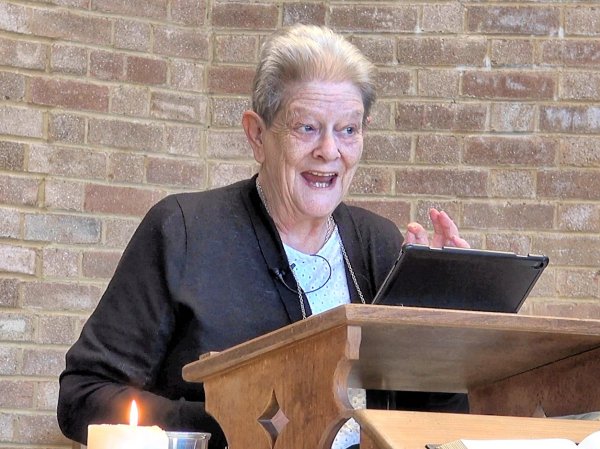
So didn’t it make sense to listen carefully to those 20,000 words recorded as spoken by probably the most significant person in the history of history, Jesus Christ, the Son of God.
As we were getting ready to enter the season of Lent, would each of us make a commitment to listen carefully to Jesus, and then actively respond. Simple it might sound, but actually it might be quite a dangerous proposition, because there was no way to predict how doing that might totally transform our lives.
Peter, John, and James on that mountaintop had seen something that had always been, would always be – the light of divinity fully manifest in a human being – something a mirror could never reveal. And although the whole of creation participated in the glory of God, it was only humanity that was called to the Mount of Transfiguration. It was there that Christ revealed who we were, and who, by God’s grace, we were to become.
 Potters Bar United Reformed Church