
Sunday 29th December – Family Service led by John Wainwright
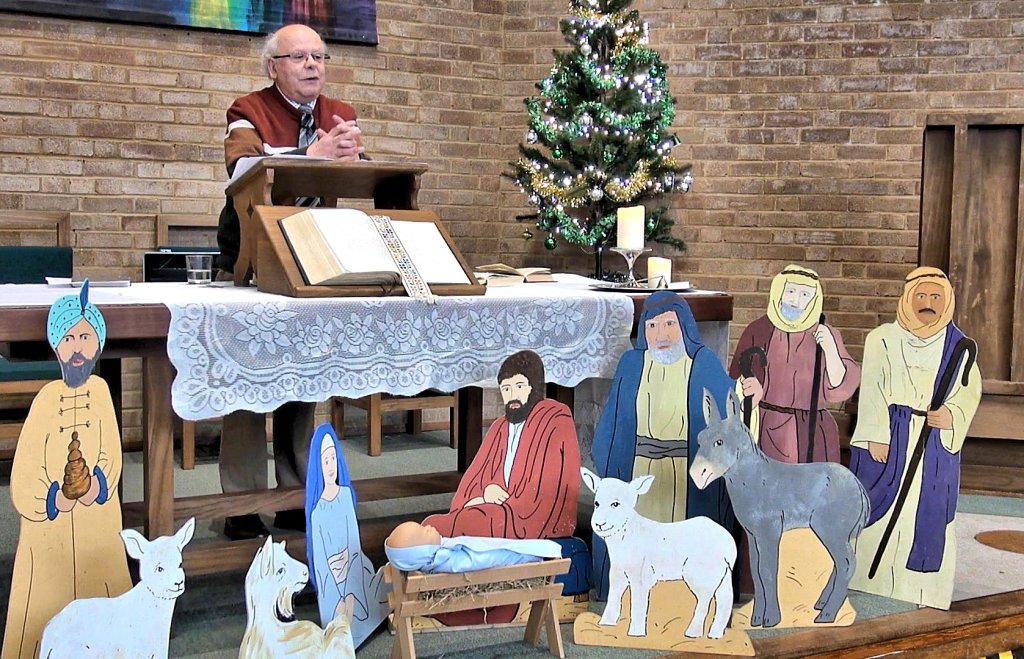
Good to have John and Sue back with us to see us into the New Year.
With all the bad things that had happened in the world this year John wanted us to think about some of the good things that had happened. Well, some – including John – gave thanks for wives who had put up with them for 49 or 40 years (and quite a few more were thinking the same thing). Then we had the birth of a great grandson, and the church as a whole gave thanks for our 90 years of existence. There were lots of things unspoken that we needed to be thankful for and John thought it was good to focus on the positive things in life – remembering that the world and everything in it is in the hands of God.
John then confessed to us that behind that familiar face was a Proud Northerner who came from the High Peak (on the Derbyshire, East Cheshire border). Hoping for fame and fortune on the radio, in response to a request for a verse from a hymn that was a particularly good expression of the Incarnation, he’d submitted a verse from the hymn by John Wesley that we were about to sing, “Our God contracted to span, incomprehensively made to man”. His hopes for fame had been dashed by Vicky, who had pipped him to the post with the same verse. Vicky, it transpired, also came from the Hight Peak which John felt showed that God had a sense of humour.
Sue Wainwright read the Gospel Reading from Luke 2, “The Boy Jesus in the Temple”.
John noted that we were told very little in the Bible about the childhood of Jesus, seeming to go more or less from his birth stories directly to his public ministry. He felt that the Gospel writers had mostly wanted to focus on what they believed to be the uniqueness of Jesus – his birth, his ministry, his death and resurrection. Luke had made a brief exception, showing Jesus doing what a normal Jewish boy who had been brought up in a religious household would do – going to the Temple yearly with his parents, who were obviously a very devout couple. And that particular occasion would have been important for Jesus, because he was 12 years old, one year prior to taking his Bar Mitzvah, which meant becoming a ‘son of the law’ and taking on responsibilities of manhood and particularly spiritual responsibilities.
And Luke was writing to Gentiles who lived in Asia Minor who would have been very familiar with how emperors were appointed. What Luke wanted to do was to show that Jesus’s appointment was far greater and better than any human appointment. It was direct from God. And at that particular time Jesus would seem to have come to a realisation that he was God’s chosen one. He’d reached an age at which he’d begun to think deeply about God’s will for people’s lives and come to an awareness that he would be a very special child.
By staying back in the temple when his parents left, he’d caused them a lot of worry and no doubt some mutual recriminations. So when after three days Mary finds Jesus in the Temple she asks him why he’s messed them about. And then Jesus, of course, turns this round when he says, “Didn’t you realise I would be in my father’s house”. And we’re told he impressed the Jewish teachers at the religious school in the Temple. During Passover the great teachers would do their teaching in public in one of the outer courts. People could go and ask questions and listen to the teachers, and that was what Jesus did.
And this, John felt, reminded us of the importance of giving a good, sound example to our children – and indeed to our grandchildren. If we could encourage them to find faith in God, then how much benefit that would be to their lives as children, as young people and as adults. (And he made the point that when taking children or grandchildren to church, we shouldn’t necessarily take them to the church where we normally went. We should try to find a church where they would find other young people of their age group).
With New Years Eve just days away, John (with NY resolutions in mind) talked about change – something that as he gets older, he likes less and less.
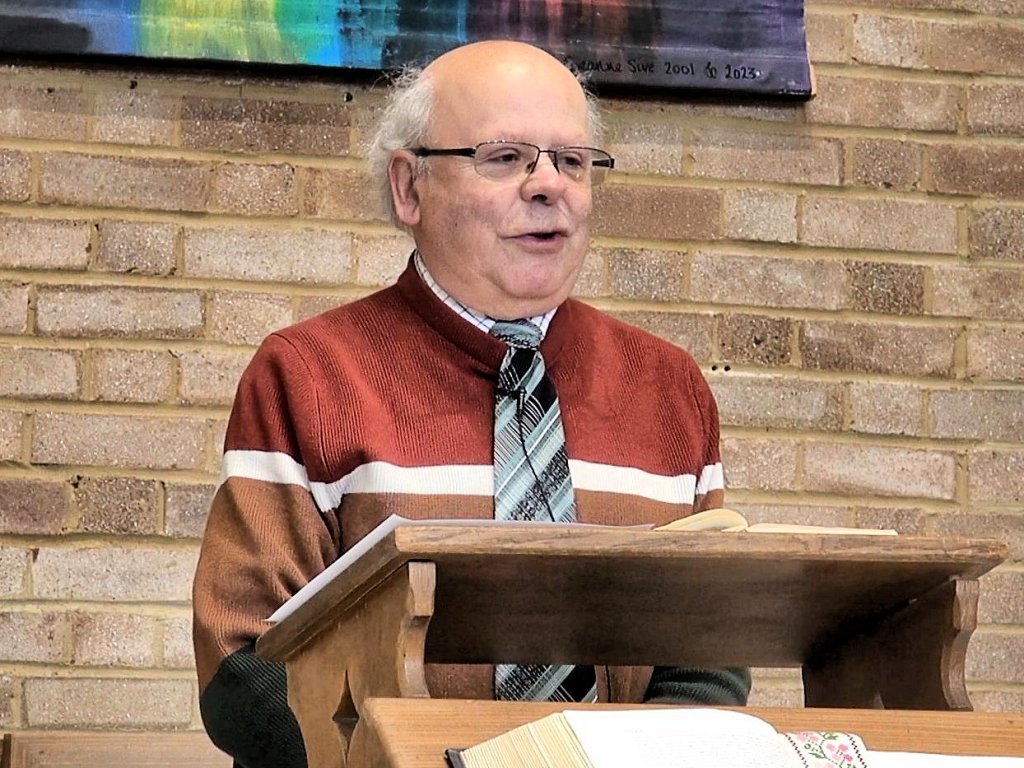
God might be unchanging, but God was a God anxious to make things new. To do new things with our lives, with our church, so that we might be places of growth rather than decline. So it would be John’s prayer as we prepared to go into a new year, that we would allow God to make our lives new.
How might this affect our church? It was not for John to say, but it was important to be balanced in our faith. It was good to have social events which would encourage people to come in, but we also needed events which would encourage people to grow spiritually, to focus more on the reading of God’s Word.
He closed with some words from Francis Ridley Havergal:
Another year is dawning, dear master, let it be
in working or in waiting another year for thee.
Another year of mercies, of faithfulness and grace.
Another year of gladness in the shining of thy face.
Another year of progress. Another year of praise,
Another year of proving Thy presence all the days.
Another year of service, of witness for Thy love,
Another year of training for holier work above.
Another year is dawning, dear master, let it be,
on earth or else in heaven, another year for thee.
 Potters Bar United Reformed Church