
Sunday 24th November – Family Service led by Llian Evans
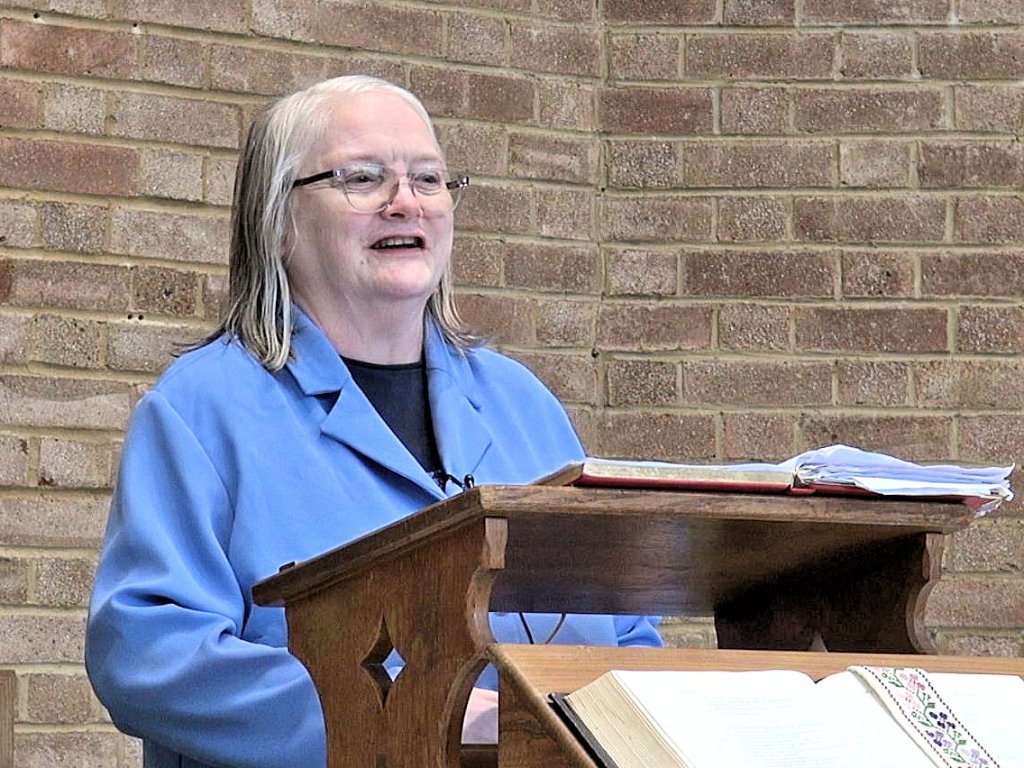
With storm Bert still lashing us, we feared Lilian might not make it (stranded on the M25) . Our Elders had decided to go ahead with the Service but in fact she arrived in the Nick of time (well clearly not that Nick!) and moved seamlessly into the meat of the Service.
Lilian told us that this Sunday we were at the end of the traditional prayer book and church year with the Service for Christ the King. The new church year and its story started on the 1st Sunday of Advent – well at least until some bright spark in the United Reformed Church had decided that we ought to fit our prayer books to the normal calendar year (sic).
The story of the Messiah went back a long way: only a few weeks ago we’d learned the story of Ruth, part of Jesus’s story because she was the mother of Jesse who was the mother of King David. And Jesus belonged to David’s line. Matthew and Luke list Jesus and Joseph’s genealogy going back to David and Abraham. The latter was probably a good place to start if you were writing to a Hebrew community.
Mark started in a different place: the first thing you heard about Jesus in his Gospel was Jesus’s baptism. If you’d been to a baptism, you would have found that as they came out of the water they were told they were now alive in Christ.
Psalm 132 (the OT reading) was described as a song of ascent, usually sung on the way up through the city to the temple, the eternal dwelling of God in Zion. King David had been allowed to gather materials for the temple but not to build it. That had been left to his son. Then in John 18 we’d heard about Jesus being brought before Pilate.
Lilian had mixed feelings about Pilate but recognised that somebody had to be in position of authority in Jerusalem and in the Jewish lands at the time of Jesus (and we’ve heard previously that the job was politically a poisoned chalice trying to keep the lid on a pretty unruly population). He was answerable to Caesar but had to maintain a good relationship with local priests and other important people in the land. So when Jesus came before him he wanted to establish some facts and asked Jesus, “Are you King of the Jews?”. Lilian felt that at the time there technically wasn’t a King of the Jews because the nominal King was a sort of general “Dog’s body” under the reign of Caesar.
Was this a simple question or had somebody hinted that there was a problem in the city, with some people saying he was the king and others not? If Jesus had said, “Yes, I’m the King of Jews”, Pilate could have said, ”Well, I can get rid of you then. You can’t be king, because Caesar is the one who rules the country”. He knew that the priests had it in for Jesus.
Jesus was king, but not there, and not at that time. Even today it was not often that you heard Jesus being called ‘King of the Jews’ by people, because they didn’t recognize him as such. Kings had armies to fight and people to protect them. Pilate says, “Are you a king?” and Jesus answers, “You say that I am a king”. Pilate says “No, no, no, no! I’m asking you if you’re the king”, and Jesus says, “I am a king, but not a king like you’re thinking. I was born of David’s line so can claim to be a king. I was born to tell the truth and everyone who belongs to the truth listens to me”.
Pilate asks one more question, “What is the truth?”. What was the truth that we talked about? It was one of those things which you had to say you believed. All these things added up, but the thing was you had to believe that they were the truth.
One of the things to think about was whether we were hearing what God was saying. Lilian then told us about the fire in her house and that she’d had to leave whilst they were repairing the damage – which was taking its time. And she had found herself relying more and more on people who just phoned her up to say they were thinking of her. Knowing that people had been praying for her gave her a great boost. She always felt it was more blessed to be prayed for than to pray. Just allow other people to lift you in prayer.
Many years her sister had been ill with cancer. People were praying for her even while she was still teaching. The question was what should they pray for. Lilian would have liked her sister to have recovered and carried on living. Others were praying just that she would be given the strength she needed to witness to Jesus where she was, whatever she was doing. It was amazing when you prayed, and amazing when things changed – and the witness that you could have in a hospital bed could still be absolutely amazing. But you had to have the confidence in your heart that you knew where you were going. Her sister had said that she wanted to be there to witness to Jesus’s love and his care.
Lilian had been sitting, preparing for a Service when she’d heard a big bang. And then she gave us a blow-by-blow account of the fire which had started at her neighbour’s house. And it had brought to mind a Salvation Army event where they were singing “Let the fire fall, let the fire from heaven fall”. They were waiting and expecting the Pentecostal fire. Those disciples in the inner room shut away, afraid probably, and all of a sudden there was fire in the room alighting on the different disciples heads, and they began to speak in another language, so they could go out and spread the good news that Jesus was alive and had sent his spirit to us.
And sitting in the Travel Lodge restaurant earlier in the week she’d seen the snow and thought about the coming Sunday Service. It was not quite the bleak mid-winter yet, and frosty winds were not moaning (though there was plenty of warm wind and trees down during the Service!), but we were in God’s presence because Jesus had come and sent His Spirit to be with us.
Which took us neatly into the next hymn, “In the bleak mid-winter”.
 Potters Bar United Reformed Church